
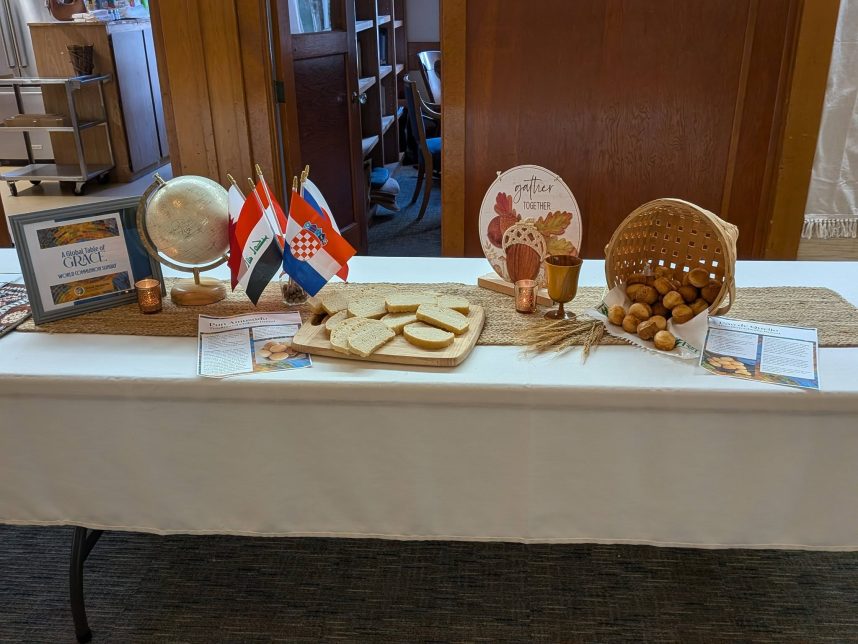
Last Sunday was World Communion Sunday. Hands down, it is my favorite Sunday of the year. Truth be told, I love it even more than Christmas and Thanksgiving combined. On World Communion Sunday, I get giddy!
World Communion Sunday was the brainchild of the Rev. Dr. Hugh Thomson Kerr and his congregation in Pittsburgh in 1933. It took shape in a time of rising nationalism and growing political extremism. Adolf Hitler had just become chancellor of Germany, and authoritarian movements were gaining strength across Europe. Against that backdrop, Kerr and his congregation worried about totalitarianism—and about the church’s responsibility to stand against it. They offered a different vision: Christians connected across national, denominational, and political divisions. World Communion Sunday proclaims that no border, government, or human-made boundary can erase our belonging to one another in Christ. We are many peoples, but one body. And when we gather at the table, we proclaim not only what the world is, but what God calls it to become. Bread makes us kin.
Rev. Kerr’s vision has always captured my imagination. On World Communion Sunday, I imagine the sun rising over the Kiribati Islands in the Pacific, near the International Date Line. Then, like a relay, the celebration moves westward—from Tokyo and Manila to Kathmandu and Mumbai, then Nairobi and Lagos; across the Atlantic to New York and the Bahamas, then Evanston, Illinois, Napa, and onward to Honolulu. By the time we broke bread in Napa, it had been 25 hours since the sun had risen over Kiribati.
Over the years, I have turned the Saturday before World Communion Sunday into a personal ritual of searching for bread from around the world. When I was a pastor in the little town of Green Bay, Wisconsin, I would drive to Milwaukee to find breads from around the world. Later, as a pastor in Evanston, I would visit Chicago’s bakeries. This year, I rose at the crack of dawn and drove to San Francisco for bread from the Russian bakery, freshly baked bread from the Japanese bakery, and other places. Then I went on to Oakland for bread from Ethiopia and Kenya.
I took a taxi from the parking garage to Cinderella Bakery to pick up a loaf of Russian black bread, then continued on to Japantown for Japanese milk bread—shokupan. My driver had offered to wait for me. When he saw me heading from one bakery to another, he laughed and said I seemed to be “bakery-hopping,” unlike his usual customers, who go “bar-hopping”. That gave me the perfect opening to tell him all about World Communion. He had immigrated from Yemen many years ago, and catching the bread vision, he said he wished he had known earlier, so his grandmother could have made us some bread from Yemen. “Next year!” I said as I took down his phone number. As he was dropping me off, he said, “This is a wonderful thing. If people from around the world can’t be at the same table, they are symbolically represented with their bread!” Then, as I stepped out of the cab, since we had shared our experience as first generation immigrants, he laughed and cheekily said, “I hope ICE doesn’t come and take away your bread!”
I thought about his remark. Imagine it: loaves of bread in every shape, texture, and color, cuffed by masked men, stuffed into sacks, hurled into the trunks of unmarked cars, and whisked away at high speed, destination unknown. I wondered “What would the congregation do”? “Cuff me to the bread” would be my response. “You take the bread, you take me!”
My last stop on the bread-shopping trip was Abyssinia Bakery in Oakland where, after purchasing Ethiopia’s Injera I exclaimed to my son who was with me, “Amazing! Bread makes strangers kin”! For the first time in a day that was much too long for him, my son lit up and said, “I have a surprise”! Then he drove me to his favorite coffee shop: Kinfolk. So there we were. Me and my kin.
Grateful to the Jesus story that has made you and me kin!
Love, Grace

